How the six pieces have to fit each other
1. Flow, not pressure, is what the kit is built around
Every consumer electric pressure washer on the market has more than enough pressure to clean a car. Almost none of them has generous flow. That matters because the two jobs a pressure washer does in a car wash — making foam and rinsing it off — are both flow jobs. A foam cannon works by forcing water through a soap solution and an orifice; the more water per minute, the thicker what comes out. Rinsing is the slow part of a wash, and flow is what shortens it.
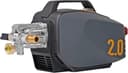
The practical numbers from our own picks: the Active is rated at 2.0 GPM, while the Kärcher K1700 Cube and the Westinghouse ePX3050 are rated at 1.2 GPM. That is roughly two-thirds more water per minute at the top of the range, and it is the difference you feel. We make the full argument, with every machine ranked on rated flow, in our pressure washer roundup.
One warning about the number on the box. Many manufacturers publish a peak or “max” figure measured at the pump rather than a rated output at the nozzle, and Pro Tool Reviews has documented how far those headline claims can sit from bench-measured performance. The Westinghouse is unusually honest about it and publishes both: 2100 max PSI and 1.76 max GPM on the box, 1800 rated PSI and 1.2 rated GPM in the specification table. Budget your expectations around the rated pair. There is more on this in what PSI to pressure wash a car.
2. The cannon has to physically fit your wand
This is the most common failed purchase in the category, and it is entirely avoidable. A foam cannon attaches to the end of your wand, and there are two separate fittings to get right: the inlet where the cannon meets the wand — usually a 1/4 inch quick-connect on American electric machines, though some use a proprietary bayonet — and the threadon cannons sold for M22 wands. Kärcher is the usual culprit, because several of its consumer machines use a Kärcher-specific bayonet that needs an adapter.
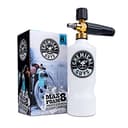
Before you order, look at the end of your wand and name the fitting. Chemical Guys itself flags this on the TORQ listing — check the connector matches your washer — and adapters are cheap and widely available, so the fix is trivial once you know. What you cannot do is buy a cannon and hope. We compare the cannons themselves in best foam cannons, and the budget AstroAI listed there commonly ships with a quick-connect adapter in the box if you would rather not buy one separately.
A separate note on machine-plus-cannon bundles: the Westinghouse ePX3050 ships with a foam cannon and a turbo nozzle, which makes it close to a complete starting setup for roughly what a good standalone cannon costs. It is the cheapest sensible way into this. A bundled cannon is a starter piece rather than the equal of a dedicated one, but it washes a car out of the box, and that is a real advantage when you are buying everything at once. The turbo nozzle in that same box should never be pointed at bodywork — more on that below.
3. The soap has to be made for a cannon, and ideally for a bucket too
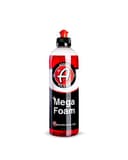
Cannon soap and bucket shampoo are not the same product category, and buying one bottle for both jobs is what keeps this kit sensible. A dedicated snow foam is formulated to cling and dwell; a bucket shampoo is formulated for lubricity during the contact wash. Adam’s Mega Foam is our pick specifically because it is written for both — the listing rates it for foam cannon, foam gun and bucket use — and because it is pH neutral, so it will not strip a wax or coating you have already paid for.
Its honest weakness is that the listing does not state a dilution ratio, so you are calibrating by eye on the first wash. Start weak and work up; it is a concentrate, and past a point more soap does not make thicker foam. If you want a bigger bottle, or want to split the two jobs across two products, the alternatives are ranked in best foam cannon soap and best car wash soap. And if you are wondering whether the foam is doing anything at all, read snow foam vs car shampoo.
4. You still need two buckets. The pressure washer does not replace them
This is the link people assembling a pressure-washer kit most often skip, and it is the one that decides whether your paint picks up swirls. Foam and a rinse remove loose dirt. They do not remove bonded road film, and the contact wash that does is also the step that drags grit across clear coat if the grit has nowhere to go. That is the entire argument for the two-bucket method, and it is unchanged by owning a pressure washer.
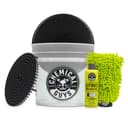
The Chemical Guys bucket kit is our pick because it is the fastest way to own one correctly specified bucket — bucket, Dirt Trap insert, mitt, soap and lid in a single order. Read the name carefully though: it is one bucket, and the method needs two. The second can be any pail you already own, and a standalone grit guard insert is the cheaper route if you have one in the garage. Why the insert matters at all is covered in do I need a grit guard.
5. The mitt is the cheapest safety upgrade in the chain
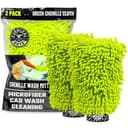
A chenille mitt costs less than a bottle of soap and is the difference between lifting grit away from the paint and grinding it back in, which is what a flat sponge does by design. The Chemical Guys chenille mitt is the sensible default: deep noodle pile, inexpensive enough to retire without regret, and plenty of water capacity to keep a panel lubricated through a pass.
If you drive something big or genuinely dirty, the mitt loads up with grit faster than you can rinse it, and that is the case for stepping up to a denser premium mitt — The Rag Company Cyclone holds more water and more grit before it needs rinsing. The full comparison is in best wash mitts, and the technique that makes either one safe is in how to wash a car without scratching.
6. Size the drying towel to the vehicle, not to the price
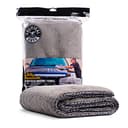
Drying is where a surprising share of wash marring and all water spotting happens, so the last link is not an afterthought. There are two approaches and the right one depends on what you drive. A big sheet — the Woolly Mammoth is 36 x 25 in — lays flat across a roof or hood and gets pulled once, which is the fewest passes and therefore the least contact your paint gets. A waffle-weave three-pack like Dry Me A River is 16 x 24 in per towel: a wipe-and-go format that is easier to handle around mirrors and door shuts, and that doubles as a glass towel.
For a truck or an SUV, buy the sheet. For a commuter car either works, and the three-pack is more useful overall. The full comparison is in best microfiber drying towels; the method that avoids spots entirely is in how to dry a car without water spots; and if you are not sure how many towels a full wash actually consumes, we counted it out in how many microfiber towels do you need.
7. The nozzle that comes in the box, and the one to leave in the box
Nearly every machine here ships with a turbo or rotary nozzle, and nearly every one of them bundles it as a selling point. It concentrates the entire output of the machine into a spinning point, and it has no business anywhere near paint, trim, badges or tyre sidewalls. Kärcher’s own car-washing guidance is explicit: always use the flat jet, never the rotor nozzle, keep at least 15 centimetres from the car’s surface and 30 centimetres from tyres, and work from the bottom up.
Put the turbo nozzle in a drawer for the driveway. Use the widest fan tip you have for everything on the car. The full method, in order, is in how to pressure wash a car, and the cannon-specific technique is in how to use a foam cannon.
8. What this page is not
It is not a ranking of pre-boxed kits. Best car detailing kits compares the actual boxed SKUs you can put in a cart as a single line item, and the beginner kit builds a starting set with no pressure washer in it at all. This page assumes you want the pressure-washer route specifically and assembles it from six separate purchases, because no single box contains these six things.
It is also not an argument that you need a pressure washer. Plenty of people wash beautifully with two buckets and a hose, and washing without a hose at all is a solved problem. A pressure washer buys you a faster rinse and a genuine pre-soak step, and those are the only two things it buys you.