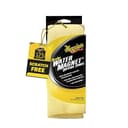
How to choose a car drying towel
Four things decide whether a towel dries a car well or quietly marks it up. Everything else is color and branding.
1. Weave: waffle or twisted loop
Waffle weave towels use a raised grid. The pockets hold water and the ridges break surface tension, so the towel keeps working even when it is damp. They are thin, dry out quickly between washes, and are excellent on glass afterwards. Twisted loop towels use long, twisted fibers with a large amount of open space between them, which is why the good ones are rated at two or three times the GSM of a waffle. They soak up more water per pass and are more forgiving on a panel that is not perfectly clean.
Neither is wrong. If you dry immediately after rinsing and want a towel that doubles for glass, take the waffle. If you would rather blot a panel once and move on, take the twisted loop. Our waffle weave vs twisted loop comparison goes through the trade-off in more detail.
2. GSM, and what it actually tells you
GSM is the fabric’s weight per square meter. Higher is generally plusher and more absorbent per square inch, but it is not a quality score — a 900 GSM twisted loop and a 390 GSM waffle are built to do the job differently, and comparing their numbers directly is meaningless. Use GSM to compare towels of the same weave. Where a maker does not publish a GSM at all, that is worth noticing: it is the one spec every serious towel brand states. What GSM means, in full.
3. Size versus panels, not versus price
A big sheet dries a roof or a hood in one drag, which means fewer contact events with your paint. It is also awkward around mirrors, door handles and bumpers, where a mid-size towel is easier to control. The setup that works for most people is a large towel for the horizontal panels and a smaller one for the rest — which is also why several picks here come in multipacks.
4. Edges
A stitched polyester border is harder than the towel it is attached to, and it is the part most likely to leave a mark on soft paint. Suede edges or fully edgeless construction removes that risk for a couple of dollars more. On a black car it is worth paying for; on a well-used daily driver it matters less.
Drying technique matters as much as the towel
Do not scrub. Lay the towel over a panel and pull it slowly toward you, or blot straight down and lift — both keep the towel gliding on a film of water rather than pressing dry fabric into paint. Work top down, so the towel meets the dirtiest lower panels last. If a towel hits the ground, it is out of the job until it has been washed; a single piece of grit trapped in a plush pile will put a scratch down the length of a door.
Two habits make the biggest difference. First, use a drying aid or spray waxas you go — a light mist adds lubrication exactly when the paint has none and leaves a little protection behind. Second, blow the water out of mirrors, badges, grilles and trim gaps first, either with a dedicated car dryer or by drying those areas last, so nothing drips down onto a panel you have already finished.
Washing and retiring drying towels
Wash drying towels separately from anything that has had wax, dressing or polish on it, with a small amount of detergent and no fabric softener. Softener coats the fibers and is the single fastest way to turn an absorbent towel into one that pushes water around. Tumble dry low or air dry. A towel that has stopped absorbing has usually not worn out — it has been contaminated, and a wash without softener often brings it back. How long one should last before that stops being true, and the three tests that tell you, are in how long microfiber towels last. If your car is coated, the shopping criteria shift — see drying towels for ceramic-coated cars.
Retire a towel from paint duty when the pile mats down, when it picks up a snagged thread, or the moment it has been used on wheels. Demote it to door jambs, sills and the engine bay rather than throwing it away. Paint towels stay paint towels; that separation is the cheapest scratch insurance in detailing, and it works exactly like the two-bucket method does for washing.
The other half of that insurance is simply owning enough of them. A wet car holds more water than one towel absorbs, and finishing a dry with a saturated towel is how water gets pushed around instead of lifted — how many microfiber towels do you need counts the real figure for drying and for a full detail. If the drying towel is part of a pressure-washer setup, the rest of the chain is in the pressure washer wash kit.
These are the most expensive towels most people own and the easiest to destroy by accident, because absorbency is the entire specification. Washing them correctly costs nothing and roughly doubles what you get out of one.