How to Pressure Wash a Car
A pressure washer does two of the five jobs in a car wash: it pre-soaks and it rinses. Done in the right order with the right nozzle it is the safest contact-free part of the whole process. Here is the sequence, the two numbers that matter, and the step most people skip.
How this is funded:we earn a commission if you buy through our links, at no extra cost to you. It never changes which product we recommend, and we’ll tell you plainly when we’d skip one. Full disclosure.
What a pressure washer is actually for
A full wash has five jobs in it: get the wheels clean, get loose dirt off before anything touches the paint, remove bonded road film by contact, rinse, and dry. A pressure washer does two of them — the pre-soak and the rinse — and it does both far better than a hose. It does not do the other three, and the single biggest mistake people make with one is assuming it does.
Understood that way, it becomes the safest part of the whole process. Nothing touches the paint during a pressure-wash stage, and almost every swirl mark on a daily driver was put there by something touching the paint — a sponge, a towel, an automatic wash brush. If a pressure washer removes some of the dirt before your mitt arrives, your mitt has less grit in it, and that is a real paint-safety gain rather than a convenience.
The two numbers worth knowing before you start
Flow matters more than pressure.Every consumer electric machine has more pressure than paint needs, and the two jobs you are doing — making foam and rinsing it off — both scale with gallons per minute. Our own picks range from 1.2 GPM rated up to 2.0 GPM rated, and that gap shows up as thicker foam and a quicker rinse rather than as cleaning power.
The number on the box may not be the number you have.Many manufacturers publish a peak or “max” figure measured at the pump rather than a rated output at the nozzle. Pro Tool Reviews has documented how far advertised claims can sit from bench-measured performance, and the honest listings publish both figures. If yours quotes two sets, the lower pair is the one to plan around. There is a longer version of this argument in what PSI to pressure wash a car.
Neither number is why a wash goes wrong, though. Nozzle and distance are.
Nozzle and distance: the only two things that can damage the car
Pressure at the pump is not force at the panel. Between them sit the nozzle, which spreads the output over an angle, and the distance, over which the jet spreads further and loses energy. A high-pressure machine with a wide fan tip held well back is gentler than a modest machine with a turbo nozzle held close.
That is why Kärcher’s own car-washing guidance does not discuss PSI at all. It gives instructions instead: always wash your car with the flat jet and not with the rotor nozzle; keep a minimum distance of 15 centimetresfrom the car’s surface and a minimum of 30 centimetres for tyres; and always clean from the bottom up, to avoid missing any spots. Follow those three and a consumer machine is fine on paint.
The turbo or rotary nozzle in your box is the one genuinely dangerous accessory. It concentrates everything the machine makes into a spinning point. On a driveway that is the whole point; on a car it will lift the edge of failing clear coat, find its way past a door or window seal, pop a loose badge or trim clip off, and etch a tyre sidewall. Put it in a drawer.
Three more places to keep the jet away from, none of which is obvious: the engine bay(electrical connectors and the air intake — use low pressure and cover things, as cleaning an engine bay sets out), stone chips and existing paint damage (an edge is an edge), and aftermarket vinyl or wrap edges, which will lift given a direct jet and enough patience.
The sequence, in order
Step 1 — Shade, cool panels, wide nozzle
Work out of direct sun. Chemical Guys makes the point plainly for waxing and it applies to the whole wash: on a hot panel, product and water flash-dry before you can deal with them, and dried soap is harder to remove than the dirt was. Touch the hood — if it is warm, wait, move into shade, or wash in the evening. Fit the widest fan tip you own before you pull the trigger once.
Step 2 — Rinse, bottom to top
First pass is a plain water rinse to knock off everything loose. Start at the sills and work up, keeping the wand moving and keeping your distance. Pay particular attention to the lower third of the car and the wheel arches, which carry the sharpest grit on the whole vehicle. Rinsing upward keeps what you have already covered wet, which is exactly what makes missed areas visible.
Step 3 — Wheels and arches, before any paint
Wheels get done first, with their own cleaner and their own brushes, and those brushes never touch paint afterwards. Brake dust is metallic and it is the single worst thing you could carry onto a panel in a mitt. The products are in best wheel cleaners and the tools in best wheel brushes; the method is in how to clean wheels and tires. Keep the jet at least 30 centimetres off the sidewalls.
Step 4 — Foam, and let it sit
Fit the cannon and cover the car, again working bottom-up so the foam clings on its way down rather than sliding straight off dry paint. Then leave it alone for several minutes. This is the step people rush and it is the one doing real work: the dwell is what softens bonded road film so your mitt removes it with less pressure. What you must not do is let it dry — if a panel starts going matte, rinse that panel now.
Foam is a pre-wash, not a wash. It will not remove bonded film by itself, and no amount of thicker foam changes that, which is the honest answer in snow foam vs car shampoo. The cannon-specific technique — ratios, dial settings, why your foam is thin — is in how to use a foam cannon.
Step 5 — Rinse the foam off
Fan nozzle back on, bottom-up again, and be thorough about the places foam hides: grille slats, door shuts, mirror housings, behind the wheels, the underside of the rear bumper. Soap left in a shut will run out onto a clean dry panel twenty minutes later.
Step 6 — The contact wash. This is the step people skip
Your car is now rinsed and pre-soaked and still not clean. Bonded road film needs a mitt. Two buckets, both with grit guards, one soap and one rinse: load the mitt, wash one panel in straight overlapping lines, rinse the mitt in the rinse bucket, reload from the soap bucket, next panel. Top down, so the dirtiest paint is done last. The reasoning is in the two-bucket method and the technique detail in how to wash a car without scratching.
If you genuinely cannot do a contact wash — apartment, time, weather — a rinseless wash is the honest compromise and it is covered in best rinseless washes. Foam and rinse alone is not.
Step 7 — Final rinse, then dry immediately
One more full rinse, then dry straight away. Water left to evaporate is exactly what leaves spots, and on hard water those spots can etch. A large drying towel laid over a panel and pulled is the fewest passes and therefore the least contact; a blower gets water out of the places a towel cannot reach at all. The method is in how to dry a car without water spots.
In winter, the order changes
In salt season the underside of the car matters more than the paint does, and a pressure washer is the only practical home tool for it. Flush the arches, sills and underbody first and generously, before you think about the bodywork, and expect to do it far more often than a normal wash cycle suggests. The seasonal method is in how to wash a car in winter and the attachments that reach the underside are in best undercarriage cleaners.
Common problems, and what they usually are
Thin, watery foam.Almost always flow, dilution or the cannon’s mix dial — in that order of likelihood. A 1.2 GPM machine will never foam like a 2.0 GPM one.
The car dried hazy after a careful wash. The contact wash was skipped or rushed, so bonded film is still there. It looks fine wet because water fills the texture.
Water spots despite drying. You dried the panels but not the shuts, mirrors and badges, and they dripped afterwards. A blower fixes this permanently.
New fine scratches. Not the pressure washer. Look at your mitt, your towel, and whether you rinsed the mitt between panels.
What this method needs
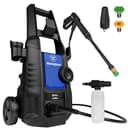
The cheapest way in
Westinghouse ePX3050 Electric Pressure Washer
It ships with a foam cannon and a turbo nozzle in the box, which makes it close to a complete starting setup for roughly what a good standalone cannon costs. Westinghouse is also unusually honest with its figures, publishing a rated 1800 PSI / 1.2 GPM next to the 2100 / 1.76 max headline — plan around the rated pair. Leave the turbo nozzle in the drawer.
$109.00View on AmazonPrice as of October 10, 2026. #ad How we’re funded
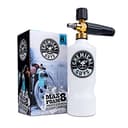
The cannon
Chemical Guys TORQ Professional Foam Cannon
Adjustable spray pattern and soap-to-water dials, which is what you want when you are learning how thick your machine can actually foam. Check the connector matches your wand before ordering — Chemical Guys flags this on the listing itself, and a mismatched fitting is the most common failed purchase in this category.
$99.97View on AmazonPrice as of October 10, 2026. #ad How we’re funded
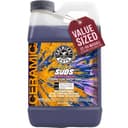
The soap
Chemical Guys HydroSuds Ceramic High-Foaming Car Wash Soap
High-foaming by design, which is the point of a cannon soap, and a 64 oz bottle so you are not rationing it while you dial in your ratio. The SiO2 content leaves a little water behaviour behind — treat that as a bonus on an already-protected car, never as protection in its own right.
$47.99View on AmazonPrice as of October 10, 2026. #ad How we’re funded

The drying towel
The Rag Company Dry Me A River Waffle-Weave Drying Towel
Step seven is not optional, and this is the format that handles it best for most cars: a waffle weave holding far more water than a flat towel its size, with suede edges so there is no stitched border to drag across paint. Three to a pack means you finish a whole car without wringing one out mid-job.
$24.95View on AmazonPrice as of October 10, 2026. #ad How we’re funded
The short version
Shade and a wide nozzle. Rinse bottom-up at 15 centimetres, 30 off the tyres. Wheels first with their own tools. Foam, dwell, do not let it dry. Rinse. Two-bucket contact wash, top-down. Final rinse, dry immediately. The turbo nozzle stays in the drawer.
Everything on that list except the contact wash and the drying is contact free, which is why a pressure-washer wash is a genuinely safer wash than a bucket-and-hose one for most people. It is just not a complete one on its own.
Work safely. Detailing chemicals and machine polishers can damage paint, trim or your own skin if misused. Always follow the manufacturer’s instructions, test in an inconspicuous spot first, work out of direct sun, and wear eye protection and gloves where the label calls for them. Two Bucket Club is general guidance from an enthusiast, not a substitute for a product’s own directions.
Frequently asked questions
Is it safe to pressure wash a car?
Yes, with the wide fan nozzle and sensible distance it is the gentlest part of a wash — nothing touches the paint. The damage risks are specific and avoidable: a turbo nozzle lifting an edge of failing clear coat, driving water past a door or window seal, blasting a loose badge or trim clip, and etching a tyre sidewall. Kärcher's own guidance is flat jet only, minimum 15 cm from the surface and 30 cm from tyres.
What nozzle should you use to pressure wash a car?
The widest fan you have — a 40 degree white tip for rinsing and soap, a 25 degree for wheel wells and lower panels if you need more bite. Never the 0 degree or the rotary/turbo nozzle, which concentrates the machine's entire output into a spinning point. Kärcher is explicit: always use the flat jet, never the rotor nozzle.
Should you pressure wash a car top down or bottom up?
Bottom up for rinsing and foaming, top down for the contact wash. Rinsing upward keeps the area below already wet so you can see what you have covered, and Kärcher recommends it for exactly that reason. The mitt stage reverses it, because the lower third of a car is the dirtiest and you do not want that grit carried up onto the roof.
How far away should you hold a pressure washer from a car?
At least 15 centimetres — about six inches — from bodywork, and at least 30 centimetres from tyres, per Kärcher's own figures. Distance matters more than the machine's rating, because the jet spreads and loses energy as it travels. The same nozzle at six inches and at two feet are effectively different tools.
Can you wash a car with only a pressure washer?
You can rinse one and take off loose dirt, but you cannot clean one. Bonded road film, brake dust and bug residue need physical contact or chemistry, so a foam-and-rinse-only wash leaves a car that looks clean while wet and hazy once dry. Pressure washing replaces the hose, not the mitt.
Will a pressure washer remove wax?
Not on its own — water pressure does not strip a cured wax or sealant. What strips protection is the chemistry you run through the machine. A strong alkaline pre-wash or a dish-detergent-style soap will take wax off quickly, which is why a pH-neutral soap is the right choice on a protected car.
How long should snow foam dwell on a car?
Several minutes, and never to the point of drying. The dwell is the whole value of the foam — it is softening road film so the mitt has less to do. If the foam starts to dry on a panel, rinse that panel immediately; dried soap is harder to remove than the dirt was, and on a hot panel it can leave residue behind.
Sources
- Kärcher — Car Washing at Home: Tips and Tricks — Pressure-washer manufacturer technique guidance: “Always wash your car with the flat jet and not with the rotor nozzle”; “Keep a minimum distance of 15 centimetres” from the car's surface and “For tyres, it should be a minimum of 30 centimetres”; “Always clean from the bottom up, to avoid missing any spots”; with the right method and that minimum distance the tyres will not be damaged (accessed October 5, 2026)
- Pro Tool Reviews — Pressure Washer PSI That's Too Good to Be True? It Probably Is! — Independent bench measurements of "PSI Max"/"GPM Max" claims vs PWMA-certified rated performance (accessed July 19, 2026)
- Chemical Guys — Two Bucket Method Car Wash Guide — Manufacturer how-to on the two-bucket wash and grit guards (accessed July 19, 2026)
- Chemical Guys — Why Waxing Your Car In Direct Sunlight Could Be A Mistake — Manufacturer guidance on waxing temperature: sun makes wax flash-dry into streaks and residue, a 50–85°F working range, check the surface is cool to the touch, allow 30–60 minutes in shade to cool, and work early morning or late afternoon (accessed September 18, 2026)
- International Detailing Association — Detailing Resources — IDA's public detailing resource library (accessed July 19, 2026)
Keep reading
Best Pressure Washers for Car Detailing
The machines ranked on rated flow rather than headline PSI, because flow is what rinses a car.
See the picksBest Pressure Washer Car Wash Kit
The six pieces this method needs, with the fitment specs that decide whether they work together.
Build the kitWhat PSI to Pressure Wash a Car
Why the number on the box is usually a peak rather than a rating, and what actually matters instead.
Read the answerThe Two-Bucket Method
The contact wash step this guide hands off to — and the one a pressure washer cannot replace.
Learn the method