How to Wash a Car Without a Hose
No spigot, no driveway, no pressure washer — and no reason to keep driving a dirty car. A bucket, a stack of towels and a rinseless concentrate will clean it safely in a parking space.
How this is funded:we earn a commission if you buy through our links, at no extra cost to you. It never changes which product we recommend, and we’ll tell you plainly when we’d skip one. Full disclosure.
Why this is worth doing properly
A lot of people in apartments, condos and shared parking end up with two options they do not like: drive through an automatic wash with spinning brushes, or leave the car dirty. The brushes are the worse choice by a distance — they are the single most reliable way to put swirl marks into a clear coat, because they carry the grit from every car before yours.
The third option is a bucket. A rinseless concentrate diluted into a couple of gallons of water will clean a lightly to moderately dirty car with no hose, no runoff and no noise, in about half an hour in a parking space. The chemistry does the part the water volume normally does — polymers encapsulate the dirt so it releases from the paint and stays in the towel.
What you need
- A rinseless concentrate. One bottle covers a great many washes because the dilution is heavy.
- A bucket, ideally with a grit guard in the bottom.
- Six to eight plush microfiber towels. This is the part people under-buy, and it is the part that keeps the method safe.
- A dedicated drying towel.
- Optional: a pump sprayer of the same solution to pre-soak the dirtiest areas before you touch them.
The three things that make it work
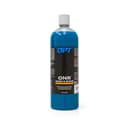
The concentrate
Optimum No Rinse Wash & Shine (Version 5)
The rinseless benchmark, and it dilutes far enough that one bottle covers a long run of washes. It doubles as a clay lubricant at a stronger mix.
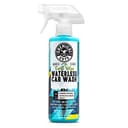
For dust-only days
Chemical Guys Swift Wipe Waterless Car Wash Spray
Ready to use, cheap and it lives in the trunk. For a car carrying nothing but light dust, this is faster than mixing a bucket.
$12.97View on AmazonPrice as of October 18, 2026. #ad How we’re funded

The drying towel
The Rag Company Dry Me A River Waffle-Weave Drying Towel
Three waffle-weave towels, so you can dry each section immediately and still have a clean one left for the glass at the end.
$24.95View on AmazonPrice as of October 18, 2026. #ad How we’re funded
The wash, step by step
The method rewards patience and punishes shortcuts. Work in the shade, ideally on a cool car, and give yourself half an hour rather than fifteen minutes.
- Assess the car.Finger down a lower panel. Grit means stop — the honest test that keeps this method safe.
- Mix the solution at the stated ratio, warm water if you can get it.
- Pre-soak the worst areas with a pump sprayer if you have one, and give them a couple of minutes.
- Start at the roof. Soak a towel, fold it in quarters, wipe one section in straight lines with no pressure at all.
- Refold to a clean face for the next section. Eight faces per towel, then swap.
- Dry as you go.Do not wash the whole car and come back — the solution drying on its own is what causes streaks.
- Wheels, tires and rockers last, with towels that stay retired to dirty duty afterwards.
Where people go wrong
Three mistakes account for almost every bad experience with this method. Too few towels, which forces you to reuse a dirty face. Too much pressure, from treating it like scrubbing rather than lifting. And using it on a car that needed a hose— the judgment call no product can make for you.
Get those three right and the results genuinely stand next to a two-bucket wash. Follow it with a spray waxand the paint stays slicker, which makes the next rinseless wash easier still — protected paint releases dirt with far less effort, and that is the compounding advantage of keeping something on top of your clear coat.
Cold weather, and other awkward situations
In freezing weather, do not use water at all on a car that will sit outside; you will freeze door seals and locks. Wait for a milder day, or do interior work instead. In a parking garage, a rinseless wash is the only realistic option and works well because the car is usually only dusty. In a heatwave, work in the shade in small sections — solution drying on hot paint is what leaves the streaks people blame on the product.
Work safely. Detailing chemicals and machine polishers can damage paint, trim or your own skin if misused. Always follow the manufacturer’s instructions, test in an inconspicuous spot first, work out of direct sun, and wear eye protection and gloves where the label calls for them. Two Bucket Club is general guidance from an enthusiast, not a substitute for a product’s own directions.
Frequently asked questions
Can you really wash a car properly without a hose?
Yes, within limits. A rinseless wash uses a couple of gallons in a bucket and cleans a lightly to moderately dirty car safely, with no runoff and no pressure washer. What it cannot do is handle mud, sand or winter salt — that level of grit needs flowing water to float it off the paint before anything touches it.
How much water does a rinseless wash use?
A couple of gallons in a bucket, plus a second bucket for rinsing towels if you use one. A conventional hose wash uses far more, which is why rinseless washing is also the method of choice during water restrictions and for anyone whose parking area has nowhere for runoff to go.
What do I need to wash a car in an apartment parking lot?
A bucket, a bottle of rinseless concentrate, six to eight plush microfiber towels, a dedicated drying towel, and ideally a grit guard and a second bucket for rinsing. That whole kit fits in the trunk, produces no runoff across the lot, and cleans a car in about half an hour.
Is it against the rules to wash a car in an apartment complex?
Many complexes prohibit hose washing because of runoff and water use, and most have no issue with a bucket. Check your own rules — the practical advantage of a rinseless wash is that there is no hose, no spray and no water running across the lot, which removes the reasons the rule usually exists.
What if my car is too dirty for a rinseless wash?
Do a partial job or find water. A pump sprayer of solution can pre-soak the worst areas and buy you enough margin for a rinseless wash on a moderately dirty car. If it is genuinely gritty, use a coin-op bay for the rinse and do the contact wash yourself — dragging grit across paint with a towel is the one mistake this method cannot forgive.
Sources
- Chemical Guys — Two Bucket Method Car Wash Guide — Manufacturer how-to on the two-bucket wash and grit guards (accessed July 19, 2026)
- International Detailing Association — Detailing Resources — IDA's public detailing resource library (accessed July 19, 2026)
- US EPA — Safer Choice — EPA program certifying safer cleaning-product chemistry (accessed July 19, 2026)
Keep reading
Best Rinseless & Waterless Washes
The concentrates that make this method work, compared on dilution and lubrication.
See the picksRinseless vs Waterless Wash
Which of the two low-water methods suits how dirty your car actually is.
Read the comparisonBest Microfiber Towels for Cars
You need more clean towel faces than you think — the packs worth buying.
See the towelsThe Two-Bucket Method
The full-water version of the same principle: keep grit away from paint.
Learn the method