How to Dry a Car Without Water Spots
Spots are minerals left behind when a droplet evaporates, so drying is a race. Work in the shade, dry in sections, clear the water hiding in trim — and use a drying aid where the paint has no lubrication left.
How this is funded:we earn a commission if you buy through our links, at no extra cost to you. It never changes which product we recommend, and we’ll tell you plainly when we’d skip one. Full disclosure.
Drying is a race, not a chore
Everything about water spots follows from one fact: the water leaves and the minerals stay. Tap water carries dissolved calcium, magnesium and silica. When a droplet evaporates on your paint, that mineral content is deposited in a ring, and once it has bonded — or worse, etched into the clear coat — a towel will not remove it.
So the goal is simple: get the water off before it can evaporate. Everything below is in service of that, and the two things that matter most cost nothing at all — working in the shade, and drying in sections rather than rinsing the whole car and coming back to it.
Before you dry: the flood rinse
The easiest water to deal with is water that has already left. Take the nozzle off the hose and let water flow across each panel from the top. Surface tension makes it come off in a sheet, taking most of the volume with it, and on a car with wax or a sealanton it the effect is dramatic — protected paint sheets far more readily than bare clear coat.
This one habit removes a large fraction of the drying work and is a good argument for keeping protection on the car in the first place. A well-protected panel can be most of the way dry before you touch it.
The technique that does not mark paint
Lay the towel flat over a section and pull it slowly toward you, or blot straight down and lift. Both keep the towel riding on a film of water instead of pressing dry fabric into paint. Do not scrub, do not use circular motions, and do not press — the weight of the towel is enough.
Work top down, so the towel meets the dirtiest lower panels last, and change to a dry section of towel when the one you are using stops absorbing. If a towel hits the ground, it is out of the job entirely; one piece of grit in a plush pile will draw a line the length of a door. The full range of drying towels, and which weave suits which approach, is covered in our waffle versus twisted loop comparison.
What makes drying faster and safer
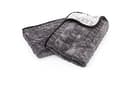
The towel
The Rag Company Gauntlet Drying Towel
900 GSM of twisted loop takes a whole panel of water in one pass, which means fewer contacts with the paint and less time for droplets to sit and evaporate.
$32.95View on AmazonPrice as of October 19, 2026. #ad How we’re funded
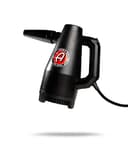
The blower
Adam's Polishes Mini Air Cannon Car Dryer
Filtered air clears the water hiding in mirrors, badges and trim gaps — the water that runs out five minutes later and spots a panel you already dried.
$104.99View on AmazonPrice as of October 19, 2026. #ad How we’re funded
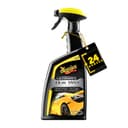
The drying aid
Meguiar's Ultimate Quik Wax
Misted on section by section, it lubricates paint that has no soap left on it and leaves a little protection behind, so the next wash sheets better too.
The water you cannot see
The most frustrating spots appear after you have finished, when trapped water runs out of a mirror housing or a badge and dries in a streak down a clean door. Deal with it before the final pass:
- Mirror housings and door handles— blow them out or open and dry them by hand.
- Grilles, badges and trim seams— the classic hiding places.
- Wheel faces and lug pockets, which stay wet long after the body is dry.
- Door shuts, fuel filler and boot seals— open each one and dry it with a demoted towel.
A blower makes this quick, and it is the strongest single argument for owning one. Without one, a smaller towel and a couple of extra minutes does the same job.
Hard water, and when to stop fighting it
If your tap water is hard, you are manufacturing the problem every time you wash. The practical answers, in order of cost: wash in the shade and dry immediately; use a drying aid — a quick detaileris the cheapest thing that does this job — on every panel; keep protection on the paint so water sheets rather than beading in place; and, if it is genuinely bad, look at a deionizing filter for the final rinse, which removes the minerals rather than managing them.
And if spots have already formed, do not attack them with more drying. Work out whether they are sitting on the surface or etched into it — our water spot remover roundup has the wet-panel test that tells you which, and what each case actually needs.
Frequently asked questions
What causes water spots when drying a car?
Minerals in the water. When a droplet evaporates it leaves behind the calcium, magnesium and silica it was carrying, which is what you see as a spot. Hard tap water, hot panels and direct sun all accelerate it, which is why drying is a race against evaporation rather than a leisurely job.
Should I dry my car with a towel or a blower?
Both, ideally. A blower clears water out of mirrors, badges, grilles and wheel pockets where a towel cannot reach and where trapped water later runs out onto a dried panel. A plush drying towel handles the flat panels far faster than air. If you only own one, make it the towel.
What is a drying aid and do I need one?
It is a spray — usually a quick detailer or spray wax — misted onto each section as you dry. It adds lubrication exactly when the paint has none, helps the towel glide instead of grabbing, and leaves a light layer of protection behind. It is not essential, but it is one of the cheapest ways to make drying both safer and more useful.
Can I let my car air dry?
Not if you care about the finish. Air drying guarantees that every droplet evaporates in place and deposits its mineral content on the paint, which is the definition of a water spot. It is the single most reliable way to spot a car, and worse on hard water.
How do I get rid of water spots that have already formed?
Try a dedicated water spot remover first — if the spot vanishes when the panel is wet and returns as it dries, it is a surface deposit and chemistry will remove it. If it remains visible while wet, or you can feel a slight dip, it has etched into the clear coat and needs machine polishing rather than another spray.
Sources
- Chemical Guys — Two Bucket Method Car Wash Guide — Manufacturer how-to on the two-bucket wash and grit guards (accessed July 19, 2026)
- International Detailing Association — Detailing Resources — IDA's public detailing resource library (accessed July 19, 2026)
Keep reading
Best Microfiber Drying Towels
Waffle weave and twisted loop compared on how much water each pulls per pass.
See the drying towelsBest Car Dryer Blowers
Clearing the water that hides in mirrors, badges and trim before it drips.
See the dryersBest Water Spot Removers
For the spots that formed anyway — and how to tell if one has etched.
See the picksHow to Wash a Car Without Scratching It
Drying is where a lot of wash swirls happen — the habits that avoid them.
Read the guide