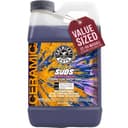
How to choose a foam cannon soap
1. pH neutral, unless you have a reason otherwise
A pH-neutral soap cleans without stripping the wax, sealant or coating you have already paid for and applied. That is what you want for a weekly wash. Alkaline “strip wash” foams exist for a specific job — clearing old protection before you apply a new coating — and using one every week quietly removes the protection you keep topping up. Our pH-neutral explainer covers why this is the first spec to check.
2. Concentration is the real cost
Foam cannon soaps are concentrates. What matters is not the bottle price but how much soap goes in the cannon per wash. A 16 oz concentrate used a couple of ounces at a time is cheaper per wash than a 64 oz bottle you have to half-fill the cannon with. Where makers publish a dilution ratio we use it; where they do not — and several do not — start at about a quarter of the cannon bottle and adjust from there.
3. Foam quality versus foam volume
The useful property is cling: how long the foam stays on a vertical panel doing its job. A thick, dry, shaving-cream foam looks impressive and can actually slide off in a sheet. A slightly wetter foam that stays put for several minutes gives the surfactants time to work. If your foam disappears before you have finished coating the car, dilute less, not more — or check whether the problem is really your pressure washer’s flow rate, which is the usual culprit.
4. Does it need to work in a bucket too?
Most people want one soap, not two. Several picks here are explicitly rated for both a cannon and a wash bucket, which means the same bottle covers the pre-soak and the contact wash. If a soap is formulated only for a cannon, you will still need a dedicated wash shampoo for the bucket stage, so factor that into the cost.
Getting thick foam out of the cannon you own
When foam comes out thin, people usually blame the soap. Work through this order instead:
- Flow rate. A foam cannon needs volume of water, not pressure. Under roughly 1.4 GPM most cannons struggle regardless of soap.
- Water temperature. Warm water dissolves the concentrate properly. Ice-cold water gives thin, patchy foam with any product.
- Fill order. Soap first, then top up with water. Doing it the other way produces a bottle of suds before you have even attached the cannon.
- The cannon’s adjustment. Most have a knob for foam thickness and a rotating nozzle for spray width. Both being wrong is common.
- Then the soap. If everything above is right and foam is still poor, the soap is the problem.
Snow foam, foam cannon soap and shampoo — the same thing?
Roughly, yes, with differences of emphasis. Snow foam usually means a pre-wash product designed to be sprayed on, dwell and be rinsed off without contact. Foam cannon soap is anything formulated to foam heavily through a cannon, which often includes dual-purpose shampoos. A plain car shampoo is built for a bucket and mitt, where lubrication matters more than foam height. The overlap is large, and our snow foam vs car shampoo guide explains where the distinction genuinely matters.
One thing all three share: foam is a pre-wash, not a wash. Let it dwell a few minutes — never let it dry on the paint — rinse thoroughly from the top down, and then do a proper two-bucket contact wash. The foam has made that contact wash far safer, which was always the point.
Dilution is the part these listings are least helpful about — several publish no ratio at all. How to use a foam cannon explains how to calibrate by eye without wasting a bottle, along with the two dials and the dwell, and the pressure washer wash kit shows where the soap sits in the chain of six things a foam wash needs.