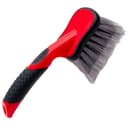
How to choose a wheel brush
Wheel brushes look basic, but a few differences decide whether one cleans safely and reaches what it needs to. Judge them on these.
1. Reach: face brush vs barrel brush
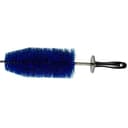
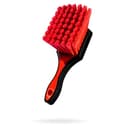
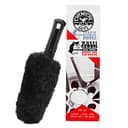
The biggest split is reach. A short-handled brush is quick and controllable on the wheel faceand outer spokes, but it can’t clean the inner barrel — where the heaviest brake dust actually collects. A long, flexible brush bends through the spokes and down into the barrel to clean the part of the wheel you never see but that sheds dust back onto everything. If you only buy one, a long flexible brush is the more complete tool; ideally you own one of each.
2. Bristle softness and a protected core
Wheel finishes scratch, so soft, non-scratch bristles matter as much here as on paint — particularly for painted, polished or coated wheels. Just as important is a protected core and tip: the wire or plastic spine of a long brush must be sheathed so it can’t rake a bare metal edge across the finish when you push it into a barrel. Cheap brushes with an exposed tip are a scratch risk; every long brush worth buying protects it. If your wheels are gloss black or powder-coated, that stops being one criterion among several and becomes the only one that matters — we sort the same brushes on it in best wheel brushes for gloss black wheels.
3. One brush, or a set of sizes
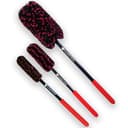
Wheels come in wildly different designs, and a set of graduated sizes — big for open faces and barrels, small for tight multi-spoke designs and lug areas — cleans a complicated wheel far faster than fighting it with one brush. A set is more money, but if you have intricate wheels or clean several cars it pays for itself in time and in not scratching a wheel by forcing the wrong-size brush into a gap.
4. Keep it off the paint, and rinse it out
A wheel brush picks up abrasive brake dust and grit, so it must stay a dedicated wheel tool — never use it on paint, and keep it away from your soft interior brushes. Rinse it thoroughly after every use so trapped grit doesn’t dry into the bristles and get dragged across a wheel next time. Treat the wheels, and the tools that clean them, as the grittiest job on the car — because they are.
Where a wheel brush fits in the wash
Wheels get cleaned first, before you wash the paint, so the fallout and cleaner you blast off them don’t land on a freshly-washed body. Rinse the wheel, spray on a cleaner suited to the finish, then use your brushes to work the face, spokes, lug area and barrel before rinsing thoroughly. For heavily embedded, rust-flecked dust, follow with an iron remover. The full routine is in our wheels and tires guide, and the brake dust guide covers the bonded stuff that plain cleaner leaves behind.
A good brush turns wheel cleaning from the worst job of a wash into a quick one — and keeps you from scratching an expensive wheel while you do it.