How to choose an undercarriage cleaner
1. Work out which of the three jobs you are actually buying for
“Undercarriage cleaner” is one phrase covering three unrelated products, and every disappointed review in this category comes from someone who bought the wrong one of the three.
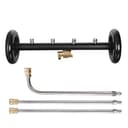
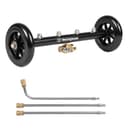
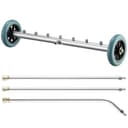
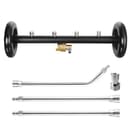
The toolis a wide bar on wheels or skids with spinning nozzles, fed by a pressure washer or a hose, that you push under the car. It solves access — the problem that you cannot get a normal wand into a six-inch gap without lying in slush. The chemistry is a concentrate that dissolves and neutralizes chloride rather than merely diluting it, which is a genuinely different action from rinsing. The protection is a film sprayed onto clean, dry metal that stays there and keeps the next batch of brine off it.
You do not need all three to start. If you drive a salted road and own a pressure washer, the attachment is the highest-value first purchase, because frequency beats thoroughness here and the attachment is what makes a winter rinse a two-minute job rather than a chore you skip.
2. Reach matters more than width
Width is the number every listing leads with, and it is the second most important spec. A car is roughly six feet across. If the head only travels three feet in from the sill, you have rinsed the rocker panels and left the middle of the floorpan — where salt slurry actually collects — untouched.
So count the extension wands, not just the inches. Three short wands is enough to push a head all the way under a sedan and out the other side; one wand is a tool for rinsing the edges. This is the single reason our top pick is the one it is, and it is the spec most listings bury below the fold. Where the listing does not state a wand count at all, our spec table says Not listed rather than filling in a plausible number.
Width earns its keep on big vehicles. On a full-size pickup a 24-inch head genuinely cuts the number of passes, and passes are the thing you get tired of in February. On a low hatchback the same head may not clear the front valance, and you will spend longer aiming it than washing with it.
3. Match the attachment to your machine, not the other way round
Two specs decide compatibility, and buyers usually check only one. The pressure rating is the ceiling the attachment can survive; run a gas washer through a part rated below it and the failure is the plastic body, at pressure, near your face. The flow rating is the one that decides whether it works well: an undercarriage head splits one water supply between many nozzles, so a wide head on a low-GPM electric washer produces a lot of gentle dribbling and not much cleaning.
If you already own a machine, buy the attachment that names your type explicitly. If you are buying both, our pressure washers for detailing roundup makes the case that rated flow, not the PSI number on the box, is the spec worth paying for — and that argument is even more true here than it is for washing paint. Connector standards are mercifully boring: most consumer machines use a 1/4-inch quick connect, and most attachments ship with one.
4. If you do not own a pressure washer, you are not locked out
This is worth saying plainly, because the category assumes a machine and most drivers do not have one. Flushing salt is not a high-pressure job. It is a volume and placementjob — you are trying to get a lot of clean water into chassis rails, wheel-well liners and the seams behind the bumpers, and dissolved salt leaves willingly once water reaches it.
A hose-compatible undercarriage head does that. What it will not do is remove baked-on road film, caked mud or the tar-and-grit crust on a wheel arch after a long winter — that needs real pressure or a proper wash. Treat the hose option as the mid-winter flush between full washes, which is exactly the cadence that actually protects a car. If a hose is not an option either, rinseless washing covers the paint but explicitly does not cover this: gritty, salted cars need flowing water, and a bucket cannot reach a subframe.
5. Water dilutes salt; it does not neutralize it
This is the part most people miss, and it is why a car that looks rinsed can still corrode. Water carries away the salt it can reach. Chloride sitting inside a lap joint, a seam sealer gap or the inside of a boxed section is not reached by a passing spray, and what water does reach it can leave behind as it evaporates.
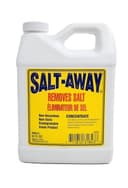
A salt-removing concentrate is formulated to break that up and carry it out rather than dilute it in place. It is not a wash soap and it is not a substitute for one — you still want a proper pH-neutral car wash soap for the paint, because a wash that strips your wax in January is a bad trade. Think of the concentrate as the last step of the rinse, on the parts nobody sees.
Be skeptical of what these products claim beyond that. Ours is picked partly because the manufacturer publishes clear non-toxic, biodegradable and non-hazardous claims and lists cars and trucks among its applications, and partly because it has been sold for the same job since 1994. It is also marked down in our spec table for not publishing a dilution ratio, which means you cannot work out cost per rinse before buying. That is a real shortcoming, not a rounding error.
6. Protection is the cheapest part and the one people skip
Washing deals with the salt that is already on the car. It does nothing about next Tuesday. A corrosion-inhibiting film is the other half of the job, and on a per-season basis it is the least expensive product on this page.
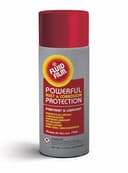
The useful distinction is between films that stay soft and coatings that go hard. A hard rubberized undercoating looks permanent and can be worse than nothing if it chips or lifts, because it then holds moisture against bare metal where you cannot see it. A soft lanolin-based film does the opposite: it creeps into seams, self-heals when stone chips hit it, and displaces water instead of trapping it. The trade-off is honest and worth stating — it stays oily, so the underside of your car looks grubby, it collects road dust, and it wants reapplying about once a year.
Apply it to a clean, dry underside, not over wet salt. Keep it well away from brake rotors, pads and hot exhaust components. If you would rather not spray anything, the fallback is simply washing more often — which brings us to the only schedule that really matters.
7. Frequency beats thoroughness
AAA’s guidance for salted-road drivers is to wash at least every two weeks, and more often after driving on heavily salted roads — using a wash with an underbody spray, and rinsing loose salt off first. That “rinse first” step matters for the same reason it does when washing paint: dragging grit around is how you make scratches, a habit covered in washing a car without scratching it. The full cold-weather routine these tools belong in — order of operations, drying the shuts, and what to leave until spring — is in how to wash a car in winter.
Two moments deserve extra attention. The first is any thaw — salt does its worst work above freezing, when brine is liquid and mobile, so a warm day in January is a better time to wash than a dry cold snap. The second is the end of the season: a thorough spring clean of the underside, wheel wells and drain channels removes the deposits that would otherwise keep corroding all summer. While you are down there, the wheel wells and brake dust are worth a pass with a dedicated wheel cleaner, since the same brine bakes onto wheel faces and barrels.
One newer wrinkle: AAA specifically flags electric vehicles as more exposed, because the battery pack, its cooling lines and a good deal of sensitive electronics all sit low and central — precisely where a salt slurry collects. If you drive an EV in the salt belt, the underbody rinse is not an optional extra.
8. What none of these products can do
They cannot reverse rust that has already started. Surface bloom on a subframe is cosmetic and slows down under a lanolin film; flaking, layered corrosion on a brake line or a fuel line is a safety item and belongs in front of a mechanic, not a spray can. If you can flake material off a structural part with a fingernail, stop reading buying guides and get it looked at.
They also cannot reach a genuinely sealed cavity. Rocker panels, box sections and door bottoms rust from the inside out, and that is cavity-wax territory with a long flexible wand, which is a different product and a different job from anything on this page. Being clear about that boundary is more useful than pretending an aerosol solves it.
The short version
If you own a pressure washer, buy the attachment with enough wands to reach the middle of the car, and use it every couple of weeks through winter and after every thaw. If you do not own one, buy the hose-compatible head and do the same thing with less pressure — it is most of the benefit for a fraction of the setup.
Add the salt concentrate if you drive a salted road daily rather than occasionally, because that is when neutralizing beats diluting. And spray the corrosion film on a clean, dry underside once a year, in the fall, before the first storm. It is the cheapest item here and the only one that works while the car is parked.
None of this is glamorous and none of it shows up in photos. It is also the single highest-return maintenance habit available to anyone who parks outdoors in a state that salts, and it costs less than one of the repairs it prevents.