How to choose microfiber towels
1. Match the towel to the surface
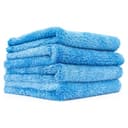
This is the decision that actually protects your paint. Use a plush, edgeless towel for anything that touches clear coat — removing wax, leveling a spray sealant, wiping a quick detailer. Use a general-purpose towel for glass, plastics, leather and door jambs. Use the cheap stuff for wheels, tires, engine bays and anything involving tar or heavy grease. A color per job is the easiest way to keep the system honest, and it is why several picks here come in a single color per pack.
2. Edges: stitched, suede or edgeless
The stitched polyester border on a cheap towel is harder than the pile it surrounds. Drag it across soft or dark paint and it can leave the very swirls you are trying to remove. Edgeless towels are cut and sealed with no border at all; suede-edged towels replace the polyester with something softer. For paint work, pay the small premium. For a door shut, it is irrelevant.
3. GSM and blend
Most quality detailing microfiber is a 70/30 polyester-polyamide blend — the polyamide is what makes it absorbent and soft. GSM tells you how much fabric you are getting per square meter: roughly 300 GSM for a general-purpose towel, 450–550 GSM for a plush paint towel. Where a listing does not state either figure, we say so rather than guessing; our GSM explainer covers what the number does and does not tell you.
4. Cost per towel, not price per pack
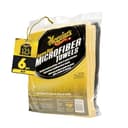
A four-pack of premium edgeless towels and a 48-pack of budget cloths can cost about the same. That is not a contradiction — they are different products for different surfaces. Work out what each towel costs and buy accordingly: a handful of expensive ones for paint, a lot of cheap ones for everything else. Buying only premium towels means you will use one on a wheel eventually, and that is the expensive mistake.
The folding habit that makes towels last
Fold a towel in quarters and you get eight usable faces. Work one face until it is loaded, then refold to a clean one. Most people use a single crumpled surface for a whole panel and wonder why residue smears — a saturated face has nothing left to absorb with, so it just redistributes what it picked up. On a wax removal, expect to use two towels on a full car: one to break the residue, one to final-buff.
The same logic applies to glass. Two towels, one damp to clean and one dry to buff, is the difference between clear glass and streaks — laid out in full in our streak-free glass guide.
Washing microfiber correctly
Wash detailing towels separately from household laundry and from each other by tier — paint towels never go in with the ones that cleaned wheels. Use a small amount of liquid detergent, warm water, and never fabric softener, which coats the fibers and destroys the absorbency you paid for. Skip dryer sheets for the same reason. Tumble dry on low or hang them; high heat can melt the fibers and leave the towel permanently slick.
If a towel has picked up wax or polymer residue and feels stiff, a wash with a dedicated microfiber detergent usually recovers it. If it comes out of the wash still slick, it is done for paint work. Demote it, do not bin it — there is always an engine bay.
How many towels do you actually need?
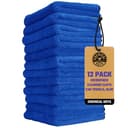
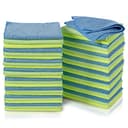
For a straightforward wash-and-protect on one car: one or two plush towels for wax removal, three or four general-purpose towels for glass and interior, and a handful of cheap cloths for wheels and jambs. That is roughly a dozen, which is why multipacks dominate this page. If you are also deep-cleaning an interior or machine polishing, double it — polishing in particular eats towels, and reusing a compound-loaded towel on finished paint undoes the work.
Whatever you buy here, the laundry room decides how long it lasts. Fabric softener ruins a towel in one cycle and heat ruins it slowly — how to wash microfiber towels has the routine, and how long microfiber towels last has the three tests that tell you one is finished.
That dozen is the wash-and-protect figure. A full detail is a different number entirely, because the count is driven by how many separate towels each stage needs rather than by the size of the car — how many microfiber towels do you need adds it up job by job and lands between sixteen and twenty-five.