Microfiber GSM, Explained
GSM is the one number every towel brand prints and almost nobody explains. Here is what it measures, why a higher number is not automatically better, and the range to buy for each job.
How this is funded:we earn a commission if you buy through our links, at no extra cost to you. It never changes which product we recommend, and we’ll tell you plainly when we’d skip one. Full disclosure.
What the number actually measures
GSM stands for grams per square meter. It is a measure of fabric density: how much material there is in a square meter of that cloth. A 500 GSM towel and a 300 GSM towel of identical dimensions are different weights because there is more fiber packed into the first one.
Note what it does notmeasure. It says nothing about the size of the towel, the quality of the fibers, how the towel is edged, or the polyester-to-polyamide blend. It is one useful number among several, and it has become the headline spec mostly because it is easy to print and easy to compare — which is exactly why it gets over-interpreted.
Why a higher number is not automatically better
Density buys absorbency and plushness. It also buys drawbacks. A very high GSM towel holds a lot of water and therefore takes a long time to dry out between washes, which matters if you store towels somewhere without much airflow. It is heavy and awkward when saturated. And on glass it is actively worse than a thin, dense weave, because a deep pile leaves lint and streaks where a flat weave leaves a clear finish.
The comparison trap is worth spelling out: a 900 GSM twisted-loop drying towel and a 390 GSM waffle-weave drying towel are both good drying towels. The waffle absorbs through its raised grid structure, so it does not need pile depth to work. Comparing their GSM figures directly and concluding the waffle is worse is the single most common misreading of this spec. Compare GSM only between towels of the same weave doing the same job — the reasoning is laid out in our waffle weave versus twisted loop comparison.
The GSM ranges worth knowing
- 200–300 GSM — general purpose. Thin, fast-drying, cheap. Right for door jambs, wheels, engine bays and rough work. Also the range most dedicated glass towels live in, because a flat, dense weave leaves the clearest finish.
- 300–400 GSM — all-rounders and waffle drying towels. The standard 16 x 16 in detailing towel, and the range for waffle-weave drying towels, where the grid rather than the pile does the absorbing.
- 400–550 GSM — plush paint towels. The buffing range: removing wax, sealant residue and coating high spots without marring the clear coat. Look for edgeless construction here as well.
- 700–1,000+ GSM — twisted-loop drying towels. Built for maximum water capacity per pass. Excellent at their job, poor at everything else, and slow to dry out.
What each range looks like in practice
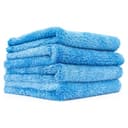
500 GSM — plush
The Rag Company Eagle Edgeless 500 Microfiber Towels
The buffing range: enough pile to lift wax residue off paint, edgeless so there is no stitched border near the clear coat.
$25.95View on AmazonPrice as of October 18, 2026. #ad How we’re funded
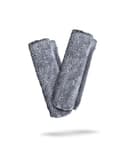
480 GSM — plush, in twos
Adam's Polishes Borderless Grey Microfiber Towel (2-Pack)
The same plush range in a two-pack, for adding a couple of paint-safe towels without committing to a large set.
$12.74View on AmazonPrice as of October 18, 2026. #ad How we’re funded
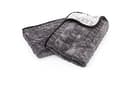
900 GSM — drying
The Rag Company Gauntlet Drying Towel
The high end, and only for drying. Deep twisted loop holds a whole panel of water in one pass, which is exactly what it is built to do.
$32.95View on AmazonPrice as of October 18, 2026. #ad How we’re funded
The specs that matter alongside GSM
The blend
Quality detailing microfiber is usually a 70/30 polyester-polyamide blend. The polyester gives structure and cleaning ability; the polyamide gives softness and absorbency. Cheaper towels run 80/20 or 90/10, which is why a bargain towel can share a GSM figure with a premium one and feel completely different in the hand.
The edge
A stitched polyester border is harder than the towel it surrounds and is the part most likely to leave a fine mark on soft paint. Edgeless or suede-edged construction removes that risk. On a paint towel this matters more than a hundred points of GSM.
Size
GSM is per square meter, so a big 300 GSM towel can hold more total water than a small 500 GSM one. When you are comparing drying towels, look at dimensions and GSM together rather than treating either as the answer.
When a maker does not publish a GSM at all
Plenty of listings state no GSM. That is worth noticing rather than assuming the worst: it is the one spec every serious towel brand publishes, so its absence usually means the towel is aimed at general use rather than at detailers. On our towel roundupswe print the figure where the listing states it and “Not listed” where it does not, because a spec we cannot verify is a finding, not a gap to fill with a guess.
In practice, buy by job rather than by number: a few plush edgeless towels for paint, a stack of standard towels for glass and interiors, and cheap bulk cloths for wheels and engine bays. That separation protects your paint far more reliably than chasing the highest GSM on the shelf.
GSM only describes a towel when it is new. What it is like in a year is decided by how you launder it — washing microfiber towels covers why softener and heat undo the specification you paid for.
Buying by job also means buying the right numberof each grade, which is where most people under-buy — how many microfiber towels do you need counts a full detail out stage by stage and explains why running short is a paint-safety problem rather than an inconvenience.
Frequently asked questions
What does GSM mean on a microfiber towel?
Grams per square meter — the weight of the fabric, not the towel. A 500 GSM towel has 500 grams of material in every square meter of cloth, regardless of how big the towel is. Higher GSM generally means a denser, plusher, more absorbent fabric for its area.
What GSM microfiber towel is best for cars?
It depends on the job. Around 300 GSM for general-purpose work, glass and interiors; 400-550 GSM for plush towels that buff wax and sealant off paint; 700-1,000 GSM for twisted-loop drying towels; and 300-400 GSM for waffle-weave drying towels, where the grid rather than the pile does the absorbing.
Is higher GSM always better?
No. A very high GSM towel is plush and absorbent but slow to dry, heavy when wet, and poor at glass, where a dense low-GSM weave leaves a clearer finish. GSM is only comparable between towels of the same weave and intended job — comparing a 900 GSM twisted loop with a 390 GSM waffle tells you nothing useful.
What is the 70/30 blend on microfiber towels?
The ratio of polyester to polyamide. Polyester provides the scrubbing and structure, polyamide provides softness and absorbency, so a 70/30 blend is more absorbent and plusher than a cheaper 80/20 or 90/10. Blend and GSM together tell you far more than either alone.
Does GSM tell you if a towel is safe on paint?
Only partly. Plush high-GSM pile does keep the fabric backing away from the clear coat, which helps. But the thing most likely to mark paint is the stitched polyester border on a cheap towel, and that is not reflected in the GSM figure at all. For paint work, look for edgeless or suede-edged construction as well as a decent GSM.
Sources
- International Detailing Association — Detailing Resources — IDA's public detailing resource library (accessed July 19, 2026)
- Chemical Guys — Two Bucket Method Car Wash Guide — Manufacturer how-to on the two-bucket wash and grit guards (accessed July 19, 2026)
Keep reading
Best Microfiber Towels for Cars
Plush, general-purpose and bulk towels compared, with stated GSM where makers publish it.
See the towel picksWaffle Weave vs Twisted Loop
Why the two drying-towel designs carry such different GSM numbers.
Read the comparisonBest Microfiber Drying Towels
The drying towels themselves, compared on weave, size and stated GSM.
See the drying towelsStreak-Free Car Glass
Where a lower-GSM towel genuinely outperforms a plush one.
Read the guide