How to choose a bug and tar remover
1. Work out whether you have a bug problem or a tar problem
Stand at the front of the car and look at what is actually on it. Dried insect bodies on the bumper, grille, mirror caps, leading edge of the hood and the lower third of the windshield are a bug problem: organic residue, water-soluble when fresh, a hard protein shell when baked. Small black flecks low down on the rocker panels, behind the wheels and along the bottom of the doors are a tar problem: petroleum, sticky rather than crusty, and completely indifferent to soap.
Most cars have both, in different places, and that is the single most common reason people decide bug-and-tar remover “does not work.” They buy one bottle, spray it on the rocker tar it was never designed for, and conclude the category is marketing. Buy for the job in front of you: the foams and soaks on this page are insect products that will also lift fresh light tar, and the Tarminator is a solvent that exists specifically for the flecks the others leave behind.
2. Dwell is the spec that matters, not strength
If UF’s finding is right — that the removal is as much of a risk to the paint as the bug — then the correct measure of a bug remover is how much softening it buys you per minute, because every minute of softening is force you do not have to apply. That reframes the whole shelf.
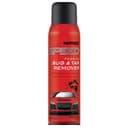
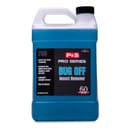
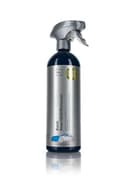
A thin pump spray on a vertical bumper runs to the bottom of the panel in about ten seconds and does nothing for the rest. A clinging aerosol foamstays put, which is why Mothers leads this page: its stated selling point is a “no-drip, penetrating foam” for grilles, vents and louvers, and clinging is the mechanism. A soak— P&S Bug Off sprayed on and left while you go do the wheels — is the same idea with more volume. And a published dwell window is worth real money: Koch-Chemie tells you to leave it on for one to three minutes, which means you know when it is working and when you are just standing there.
Three of the six products here publish no dwell time at all. That is noted as a con on each of them rather than filled in with a number we invented. In practice, if the maker gives you nothing, give it a minute, keep it wet, and test the spot with a light wipe before you commit any pressure.
3. Cool, shaded panels — this is not optional
Every manufacturer here that publishes conditions publishes the same two. Stoner says to rinse the area with water to cool it and that you must not use Tarminator on hot surfaces. Koch-Chemie says do not use on hot surfaces, and do not let it dry. Chemical Guys says to avoid leaving the active product on the vehicle in direct sunlight. The reason is identical to the reason you should not wax a car in the sun: a hot panel flashes the carrier off, the product dries into a film, and now you have two things to remove instead of one — and a cleaner drying onto hot clear coat is exactly the scenario that leaves a stain.
Do the front end first thing in the morning, in a garage, or on the shaded side of the house. Rinse the panel with cool water before you spray anything. If the car has just come off a highway in August, the bumper is the hottest painted surface on it and you are not ready to start.
4. What the chemistry does to the wax underneath
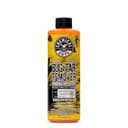
A bug remover is a cleaner, and cleaners that are strong enough to break down baked protein are usually alkaline. Koch-Chemie is explicit that its product is an alkaline cleaner and tells you to check suitability and compatibility before use. Chemical Guys publishes no pH figure for its bug-and-tar shampoo, which, given it is marketed as heavy duty, we read as “not pH neutral.” Our guide to pH-neutral car soap covers why that matters: alkaline chemistry is what strips a wax or sealant layer, and the stronger the degreaser the faster it goes.
The solvent is a different mechanism with the same consequence. Tarminator dissolves petroleum, and a wax layer is, at a chemical level, something a petroleum solvent is perfectly happy to take with it. None of this is a reason to avoid these products — leaving baked splatter on the paint to protect a coat of wax is backwards. It is a reason to plan the order of the job: decontaminate first, protect afterwards. If you have just treated half the front bumper with a solvent, that bumper needs wax or a spray sealant before you call the job finished.
5. Where it fits in the wash
Bug and tar removal is a pre-washstep, and almost every manufacturer on this page says so in the directions: spray, dwell, rinse, then wash the car. P&S frames its entire product as something you apply “prior to vehicle washing.” Koch-Chemie ends its instructions with “rinse thoroughly and then wash the vehicle.” Chemical Guys puts 2 oz of its concentrate straight into the wash bucket.
The practical sequence on a bug-covered car is: wheels first, then rinse the whole car down with cool water, then treat the front end and let it dwell while you foam the rest of the car. By the time you come back the splatter has softened and the pre-soak foam has lifted the general road film, and a single light pass with a clean mitt finishes both. Our order-of-detailing-steps guide has the full sequence; the short version is that chemistry always goes before contact, and contact always goes before protection.
6. Make contact correctly, or not at all
Sooner or later a few shells will not move. This is the moment that decides whether the car ends up clean or swirled, and it is worth being deliberate about. Three options, in order of preference.
Re-apply and wait longer.Free, zero risk, and it works more often than people expect. Koch-Chemie’s one-to-three-minute window is a guide, not a ceiling — a second application on an already-wet panel buys you another round of softening.
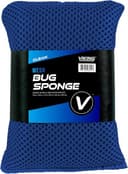
Use a mesh bug sponge, soaking wet.VIKING’s sponge is microfiber mesh over a foam core, stated by the manufacturer as clear-coat safe, and the mesh catches an edge of the dried shell in a way a flat towel cannot. The foam core’s job is to carry enough soapy water that the mesh floats rather than drags. Used on a dry panel it is just an abrasive pad, and the same rules that stop a wash from scratching apply here: plenty of lubrication, straight-line motions, rinse the sponge constantly.
Clay it. For splatter that has been baked on for weeks, a clay bar with plenty of lube shears the bonded residue off the clear coat with less force than scrubbing ever will. That is the same chemical-then- mechanical sequence our paint decontamination guide lays out, and the clay bar kits we recommend all include the lubricant that makes it safe.
7. Glass and headlights are not paint
The lower windshield takes more bug impacts than any panel on the car, and glass is the one surface where you can be comparatively aggressive — it is far harder than clear coat, and a mesh sponge on wet glass is fine. Finish with a dedicated glass cleaner, because bug remover left on glass dries into a haze that shows up the first time you drive into the sun.
Headlights are the opposite, and this is the single most important warning on this page: Stoner explicitly states that Tarminator must not be used on headlights or clear plastics. Modern lenses are polycarbonate with a UV hard-coat, and a strong solvent can craze or cloud that coat permanently. Use the water-based products on headlights, keep the solvent for painted metal and the rocker panels, and if a lens is already yellow, that is a different job for a headlight restoration kit.
8. The real fix is protection, applied before the season
The UF publication finishes with the most practical advice in the whole literature: “The front of a vehicle can be protected by coating it with ‘car wax’ and removing the lovebugs within 24 hours.” A slick, protected front end gives the splatter nothing to key into, and removal from a waxed bumper takes a fraction of the dwell and none of the scrubbing.
So the version of this that actually saves your paint is seasonal rather than reactive. Before the first warm month, wax or seal the bumper, grille surround, mirror caps and the leading edge of the hood — a spray wax on those panels takes five minutes and can be topped up every wash. Then keep a can of the foam in the trunk, and get the bugs off inside a day or two rather than leaving them to bake. The bottle you buy today solves this week. The wax you put on the bumper in April solves the summer.
The short version
Buy the Mothers foam if you want one can that handles a normal bug season without thinking about it. Buy the P&S gallon if your front end is genuinely plastered and you would rather soak the whole clip than spot-treat it. Buy the Stoner Tarminator alongside whichever you choose, because it is a few dollars and nothing else on this page touches tar. Buy the Koch-Chemie if you want a manufacturer that tells you exactly what the product is and exactly how long to leave it on, and the Chemical Guys concentrate if the whole car is filmy rather than the front end being spotted. And buy the sponge regardless — it costs less than a coffee and it is the difference between lifting a softened shell and grinding it across the clear coat.
Then do the part no product can do for you: cool panel, shade, let it dwell, and almost no pressure. The research says the removal is half the risk. Every minute you let the chemistry work is a minute of scrubbing you get to skip.