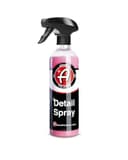
How to choose a spray wax
1. Carnauba or synthetic
Carnauba sprays give the warm, deep, slightly wet look that dark paint flatters, and they generally give up some durability to get it. Syntheticsprays give a sharper, cleaner reflection and last longer. Neither is objectively better — it is the same trade-off covered in our carnauba versus ceramic comparison, scaled down to a product you reapply every few washes anyway.
2. What it is safe to use over
This is the spec people miss. If your car wears a ceramic coatingor paint protection film, you want a spray that explicitly states it is compatible. Some products are formulated to bond with coated surfaces and some will simply sit on top, look fine for a week and mask the coating’s own beading. Where a maker states the compatibility, we have quoted it.
3. Wet application or dry
Some spray waxes are designed to be used on a wet car as a drying aid: you rinse, mist each panel, and dry with a plush drying towel, which spreads the product as it removes the water. Others want a clean, dry, cool panel. The drying-aid method is faster and adds lubrication exactly when the paint has none, which is why it is our preferred routine — but only with a product that is rated for it.
4. Bottle size versus how often you will use it
A spray wax used as a weekly top-up goes through a bottle far quicker than a paste wax used twice a year. At these prices the larger bottles are usually the better buy, and there is no real shelf-life argument against it.
How to apply spray wax without streaks
The technique is short enough to state in full. Work in the shade on a cool panel. Mist lightly — two or three sprays per panel section, not a soaking — and spread with one clean plush microfiber towel, then immediately buff with a second, dry one. The second towel is not optional; almost every streak complaint traces back to trying to spread and buff with one towel that is already loaded.
Do not apply spray wax to a dirty car. It has no meaningful cleaning ability, so all you achieve is dragging grit around a panel with a towel. Wash first, even a rinseless wash if that is all you have. The full step-by-step lives in our how to apply spray wax guide.
Where spray wax fits in a protection plan
The setup that gets the most out of it looks like this: a durable base — a sealant or a coating— applied once or twice a year onto properly decontaminated paint, then a spray wax after most washes to keep the gloss up and the water behaving. That way the spray is doing what it is good at rather than being asked to be the only thing between your clear coat and the weather.
If you would rather own one product and no plan at all, a spray wax after every wash is still a genuinely reasonable strategy. It is not what a purist would do, but a car that gets sprayed every fortnight stays protected, and that beats a beautiful coating that never got applied. Our how often to wax guide covers how to read the paint instead of the calendar.