How to choose a soap for a coated car
1. pH-neutral is the whole requirement
Ceramic coatings are silica-based and chemically bonded, and their published resistance ranges are wide — a typical consumer coating tolerates everyday cleaning chemistry without complaint. What sits outside that range is strong alkalinity, which is exactly what a degreaser is. A pH-neutral shampoo removes road film by lifting and suspending it in lubricated water; an alkaline cleaner removes it by chemically attacking the bond, and it cannot tell your coating from the grime on top of it. Our explainer on what pH-neutral soap actually means covers this in more detail, and it applies to waxed and sealed cars too — a coating just makes the mistake more expensive.
This is also why dish soap is such a bad idea on a coated car specifically. It is engineered to strip oils and films, which is a virtue in a sink and a liability on paint you have paid to protect. We cover the whole argument in can you use dish soap on a car.
2. Avoid wash-and-wax — it hides the coating you bought
This is the recommendation that surprises people, because wash-and-wax soaps are not harmful. They are simply pointless on a coated car and actively misleading. Turtle Wax Hybrid Solutions Ceramic Wash & Wax, for example, is a perfectly good cheap shampoo — it is a pick on our general wash soap roundup — but its whole selling point is that it leaves a light hydrophobic film behind. On uncoated paint that is a small bonus. On a coating it is a layer sitting between you and the thing you spent an afternoon applying, and when it wears off unevenly the beading looks patchy. You then start troubleshooting a coating that was fine all along.
The same logic applies to drying aids and quick detailers with heavy gloss polymers in them. If a product’s pitch is “leaves a protective layer,” ask yourself what it is layering onto.
3. SiO2 soaps: a genuine bonus, not protection
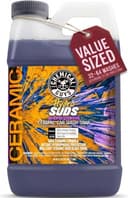
SiO2-infused shampoos like HydroSuds are the one exception worth making, because the silica they deposit is chemically compatible with a silica coating rather than sitting on it as a different material. The effect is real and it is small — a soap contacts paint for a few minutes, not the months a coating spends bonded to it. Treat it as free upkeep on your water behavior between proper top-ups, never as a reason to skip them. Our ceramic spray roundup covers the products that actually do the topping up.
4. Foam first, and use less soap than you think
A coated car is slicker than bare paint, which means contamination sits on the surface rather than keying into it, which means a pre-soak removes far more of it before you ever touch the car. That is the biggest practical change to your routine after coating: the foam cannon stage does more work than it used to, and the contact wash can be gentler. It is also why several picks here are foaming soaps rather than pure bucket shampoos.
Dilute to the label rather than by eye. Over-concentrating a neutral soap does not damage a coating, but it does leave residue that has to be rinsed off, and residue on a coating is the other common cause of “my beading looks worse.”
5. Maintenance washing is what actually preserves a coating
The failure mode for DIY coatings is almost never soap choice. It is neglect — a car left dirty for weeks at a time, so contamination has the time and heat it needs to bond on top of the coating and stay there. A coated car washed every couple of weeks with a neutral soap will outlast a coated car washed twice a year with the manufacturer’s own shampoo. Our guide on maintaining a ceramic coating covers the full routine, and how often to wash your car puts a number on the interval.
6. What about rinseless and no-hose washing on a coating?
Rinseless washing suits coated cars unusually well, for the same reason foam does: less dirt is bonded, so there is less to remove, and a coated car reaches “lightly dusty” rather than “filthy” between washes. Optimum No Rinse is rated by its maker for coatings and doubles as a clay lubricant. The limit is unchanged though — rinseless is for light to moderate dirt, never for a gritty or salted car. Our rinseless wash roundup and rinseless versus waterless explain where that line sits.