TWO BUCKET CLUB

Best Polishing Pads (2026)

The pad decides how much your compound actually cuts. These are the foam pads worth putting on a dual-action polisher — compared on cut level, size, backing-plate fit and whether they survive being washed.

By Stephen V.Last updated How we pick

Most people shopping for paint correction spend a long time choosing a polisher, a while choosing a compound, and about ninety seconds choosing pads. That is the wrong order of attention. The pad is half of the abrasive system: the same bottle of compound on a cutting pad and on a finishing pad produces two genuinely different results, and the wrong pairing is why a lot of first attempts either leave the swirls in place or add hazing that was not there before.

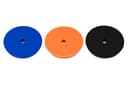
The practical framework is simple. Foam pads run from cutting (firm, aggressive, removes defects, can leave its own micro-marring) through polishing (the middle ground most one-step jobs live in) to finishing(soft, minimal cut, refines gloss and applies glazes or sealants). Manufacturers color-code within their own ranges, and the colors mean nothing across brands — a black pad from one maker is a finishing pad, from another it is a cutting pad.

Buy a set rather than a single pad. You will use two or three per car on a full correction because a saturated pad stops cutting, and cleaning one mid-job is not a substitute for swapping to a dry one. Live prices below.

How this is funded:we earn a commission if you buy through our links, at no extra cost to you. It never changes which product we recommend, and we’ll tell you plainly when we’d skip one. Full disclosure.

Quick picks

Ranked on published specs, value and buyer fit. Select a row to jump to the full write-up. We have not lab-tested these products — here is exactly what we do instead.

#ProductBest forPrice
1
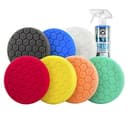
Chemical Guys Hex-Logic Buffing Pad Kit (8-Piece)

Chemical Guys Hex-Logic Buffing Pad Kit (8-Piece)

The most complete way to start: eight pads across the cut range in one box, color-coded so you are not guessing which pad goes with which compound while your polisher sits idle on the bench.

Best overall kit
$79.99View on Amazon

Price as of September 4, 2026. #ad How we’re funded

2
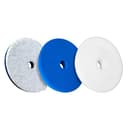
Lake Country HDO Foam Polishing Pad Kit (3-Pack)

Lake Country HDO Foam Polishing Pad Kit (3-Pack)

Lake Country is the pad brand other brands buy from, and the HDO line is their dense, heavy-duty orbital foam with a tapered edge that keeps the pad off body lines. A three-pack in 5.5 in covers a full correction on a 5 in backing plate.

Best premium foam
$48.81View on Amazon

Price as of September 4, 2026. #ad How we’re funded

3
Griot's Garage BOSS Correcting Foam Pads (2-Pack)

Griot's Garage BOSS Correcting Foam Pads (2-Pack)

The middle-cut pad in Griot's system, sold in twos and machine-washable, which is the practical spec: a pad you can clean properly and reuse costs a fraction of one you replace after two jobs.

Best mid-cut pair
$28.99View on Amazon

Price as of September 4, 2026. #ad How we’re funded

4
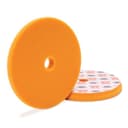
Adam's Polishes Premium Polisher Pads Bundle

Adam's Polishes Premium Polisher Pads Bundle

A color-coded bundle in 5.5 in, matched to the maker's own compounds and polishes. If you already run Adam's liquids, the pairing question disappears, which is worth more to a beginner than a small price difference.

Best color-matched set
$38.24View on Amazon

Price as of September 4, 2026. #ad How we’re funded

5
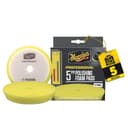
Meguiar's Professional 5 in Polishing Foam Pad (2-Pack)

Meguiar's Professional 5 in Polishing Foam Pad (2-Pack)

The cheapest sensible entry: two professional-line polishing pads at a price where replacing a worn one is not a decision. A polishing pad, not a cutting pad - pair it with a one-step product and it covers most home jobs.

Best value
$22.48View on Amazon

Price as of September 4, 2026. #ad How we’re funded

The picks in full

#1Best overall kit

Chemical Guys Hex-Logic Buffing Pad Kit (8-Piece)

The most complete way to start: eight pads across the cut range in one box, color-coded so you are not guessing which pad goes with which compound while your polisher sits idle on the bench.

What we like

  • Eight pads spanning cutting through finishing
  • Color-coded system makes pairing pad to product obvious
  • 6.5 in suits a 6 in backing plate, the common DA size

Trade-offs

  • You will use two of the eight for most jobs
  • Hex-face foam needs proper cleaning or it loads up quickly
TypeColor-coded foam pad kit
Standout spec8 pads, cutting to finishing
Size6.5 in, 8-piece
Best forBuying every cut level at once
Price tierPremium

Specs read from the product listing, on August 18, 2026. “Not listed” means the listing does not state that figure.

#2Best premium foam

Lake Country HDO Foam Polishing Pad Kit (3-Pack)

Lake Country is the pad brand other brands buy from, and the HDO line is their dense, heavy-duty orbital foam with a tapered edge that keeps the pad off body lines. A three-pack in 5.5 in covers a full correction on a 5 in backing plate.

What we like

  • Dense foam holds its shape under load instead of collapsing
  • Tapered edge reduces the chance of catching a body line
  • Three pads means you swap rather than work a saturated one

Trade-offs

  • Sized for 5 in backing plates - check your polisher first
  • Priciest pad set here per pad
TypeHeavy-duty orbital foam pads
Standout spec5.5 in, tapered edge
Size5.5 in, 3-pack
Best forA dual-action polisher on a 5 in backing plate
Price tierPremium

Specs read from the product listing, on August 18, 2026. “Not listed” means the listing does not state that figure.

#3Best mid-cut pair

Griot's Garage BOSS Correcting Foam Pads (2-Pack)

The middle-cut pad in Griot's system, sold in twos and machine-washable, which is the practical spec: a pad you can clean properly and reuse costs a fraction of one you replace after two jobs.

What we like

  • Machine-washable, so the set survives repeated jobs
  • Middle-cut foam handles most daily-driver swirling
  • Two-pack lets you swap when one loads with residue

Trade-offs

  • One cut level - you will still want a finishing pad
  • 6.5 in wants a 6 in plate and a machine with the torque for it
TypeCorrecting (mid-cut) foam pads
Standout specMachine washable
Size6.5 in, 2-pack
Best forLight to moderate correction with a mid-cut foam
Price tierMid

Specs read from the product listing, on August 18, 2026. “Not listed” means the listing does not state that figure.

#4Best color-matched set

Adam's Polishes Premium Polisher Pads Bundle

A color-coded bundle in 5.5 in, matched to the maker's own compounds and polishes. If you already run Adam's liquids, the pairing question disappears, which is worth more to a beginner than a small price difference.

What we like

  • Color-coded to match specific compounds and polishes
  • 5.5 in fits the common 5 in backing plate
  • Bundle covers more than one cut level

Trade-offs

  • The color system only helps if you buy their liquids too
  • Pad count is not stated clearly on the listing
TypeColor-coded foam pad bundle
Standout specColor-matched to compounds
Size5.5 in
Best forBeginners already using Adam's compounds
Price tierMid

Specs read from the product listing, on August 18, 2026. “Not listed” means the listing does not state that figure.

#5Best value

Meguiar's Professional 5 in Polishing Foam Pad (2-Pack)

The cheapest sensible entry: two professional-line polishing pads at a price where replacing a worn one is not a decision. A polishing pad, not a cutting pad - pair it with a one-step product and it covers most home jobs.

What we like

  • Lowest cost per pad in this group
  • Professional-line foam in a consumer-friendly 2-pack
  • 5 in size is the most common DA fitment

Trade-offs

  • Polishing cut only - heavy defects need a cutting pad
  • Two pads is thin for a full-car correction
TypePolishing (finishing-cut) foam pads
Standout specPolishing cut
Size5 in, 2-pack
Best forA first pair of pads for a one-step polish
Price tierBudget

Specs read from the product listing, on August 18, 2026. “Not listed” means the listing does not state that figure.

How to choose polishing pads

1. Match the pad size to your backing plate

This is the spec that makes a purchase useless if you get it wrong. A pad should be roughly half an inch larger than the backing plate it mounts on — a 5 in plate takes 5.5 in pads, a 6 in plate takes 6.5 in. Too small and the plate edge can contact the paint; too large and the machine bogs down and the pad flexes instead of working. Check your polisher’s plate before ordering anything on this page.

2. Pick a cut level for the job, not the worst case

Always start with the least aggressive combination that works. On a car with light swirls, a polishing pad and a one-step compound will do it. Reach for a cutting pad only when a test section proves you need it. Every pass removes a small amount of clear coat, and clear coat is finite — the point of test-section discipline is to spend as little of it as possible.

3. Foam density and how it holds up under load

Cheap foam collapses under the pressure and heat of a working polisher, which makes cut inconsistent across a panel. Denser foam holds its shape. Some pads use a tapered edge, which reduces the chance of catching a body line or a badge — a genuinely useful feature on modern cars with sharp creases.

4. Washable pads pay for themselves

A polishing pad loads up with spent compound and removed clear coat. It has to be cleaned during the job — a brush or compressed air on the spinning pad — and washed properly afterwards. Machine-washable pads survive that treatment for many jobs, which changes the cost calculation completely against cheap pads that shed and delaminate after a couple of uses. Wash them without fabric softener and let them dry face-up.

Pairing pads with compounds

The pad and the liquid work together, and both dials move. If your test section comes up short:

  • Step up the pad before the compound. Going from a polishing pad to a cutting pad with the same liquid is the smaller, more controllable jump.
  • Then step up the compound.A more aggressive liquid on a polishing pad is the next increment — see our compound roundup.
  • Finish softer. If a cutting stage leaves micro-marring, follow it with a finishing pad and a light polish to refine.

Our guide to choosing a polishing pad covers foam versus microfiber versus wool, and compound vs polish explains what the liquids are doing while the pad does its half.

How many pads do you need for one car?

For a one-step polish on a mid-size car, plan on two to three pads of the same cut. A pad that is saturated with product stops cutting predictably and starts smearing, and swapping to a fresh one takes ten seconds. For a two-stage correction, double it — you need a set for the cutting stage and a clean set for the finishing stage, because carrying compound residue into a finishing pad defeats the purpose of the second stage entirely.

That is the practical reason most picks here are multipacks or kits. Buying one pad and one compound is how a Saturday afternoon turns into a half-finished hood.
Frequently asked questions

What size polishing pad should I buy?

Roughly half an inch larger than your backing plate — a 5 inch plate takes 5.5 inch pads, a 6 inch plate takes 6.5 inch. Smaller pads are more controllable on curved panels and concentrate the machine's energy; larger pads cover flat panels faster. Check the plate on your polisher before ordering.

What do the pad colors mean?

Only what that specific manufacturer says they mean. Color coding is consistent within a brand's own range — usually running from a firm cutting foam through polishing to a soft finishing foam — but there is no industry standard. A black pad is a finishing pad in one range and a cutting pad in another, so read the description rather than the color.

How many polishing pads do I need for one car?

Two or three of the same cut for a one-step polish on a mid-size car, and roughly double that for a two-stage correction because the finishing stage needs clean pads. A pad saturated with spent compound stops cutting consistently, so swapping is part of the method rather than a sign you bought badly.

How do I clean polishing pads?

During the job, brush the face of the spinning pad or hit it with compressed air every panel or two to clear spent product. Afterwards, wash them — machine wash is fine for pads rated for it — with a small amount of detergent and no fabric softener, then air dry face-up. A pad that has been allowed to dry with compound in it is effectively finished.

Should I use a cutting pad or a polishing pad?

Start with the polishing pad. Do a test section with the least aggressive pad and liquid combination that could plausibly work, and only step up if the defects survive. Every correction pass removes clear coat permanently, so the goal is to fix the paint with the smallest amount of cut that does the job.

Sources

Keep reading